


5 Steps to Outsource ITB Management for Small Contractors
The construction bid management software market is projected to grow from $1.16 billion in 2025 to $1.36 billion in 2026, reflecting a compound annual growth rate (CAGR) of 16.4%. This growth indicates increasing adoption of structured, specialized approaches to preconstruction processes. Construction Bid Management Software Global Market Report 2026
Small contracting firms manage multiple responsibilities, including estimating, field operations, general contractor (GC) relationships, and subcontractor coordination. Bid management, responding to Invitations to Bid (ITBs), tracking deadlines, monitoring document releases, and ensuring timely submissions, often receives insufficient attention due to competing priorities.
So what does it actually look like when a contractor decides to outsource ITB management?
This guide outlines the practical steps to outsource ITB Management effectively, the scope of services involved, and the division of responsibilities between the contractor and the outsourced team.
What Outsource ITB Management Covers?
An Invitation to Bid (ITB) is a formal request from a general contractor for subcontractors to submit pricing for a defined scope of work. Many small contractors choose to outsource ITB Management to reduce internal bottlenecks and improve bid consistency while maintaining full control over key decisions.
Managing that process on the subcontractor side involves:
- Reviewing incoming ITBs and deciding which ones to pursue
- Monitoring plan releases, addenda, and specification updates
- Scoping the work accurately from drawings and documents
- Building a shortlist of relevant opportunities
- Coordinating bid support materials, forms, and submission requirements
- Tracking deadlines across multiple active bids
When managed internally alongside active projects, these tasks frequently result in delayed responses, incomplete submissions, or missed opportunities.
When you outsource ITB management, you hand off that administrative and analytical workload to a dedicated team, while retaining the decisions that require your expertise and market knowledge.

Step 1: Define the Scope Brief
The engagement starts with a scope brief, a document that tells the outsourced team exactly what you do, where you work, and what types of projects fit your business.
This typically covers:
- Your trade or trades (roofing, HVAC, electrical, drywall, fencing, etc.)
- Your service area (state, metro, region)
- Your preferred project types (commercial, institutional, multifamily, industrial)
- Your project size range (e.g., $50K–$5M jobs)
- Any GCs or project owners you already have relationships with
- Bid volume targets (how many bids per week or month)
This step is where the small contractor bidding process gets structured for the first time for many firms. You are not handing over control. You are giving a clear mandate so that the team working on your behalf can filter, prioritize, and monitor with accuracy.
The scope brief is a one-time setup that gets refined over the first few weeks of engagement.
Step 2: Monitoring and Document Tracking
Once the brief is set, the outsourced team begins active monitoring across bid platforms, tracking new ITBs that match your criteria, logging addenda, and flagging projects that are progressing toward bid day.
This is the most time-intensive part of construction bid management outsourcing, and it is also the step that gets dropped most often when it is handled internally. An estimator who is also running a job cannot check platforms daily, read every addendum, and still produce accurate pricing.
According to Autodesk Construction Cloud data, firms using digital bid tools have reported up to a 25% increase in bid win rates and a 34% improvement in estimating accuracy compared to manual methods. Top 10 Construction Bidding Websites for Contractors 2026.
The firms seeing those gains are not doing it alone, they have support structures behind their estimating process.
The monitoring step typically includes:
- Daily platform checks (BuildingConnected, PlanHub, ConstructConnect, and others)
- Addendum tracking and notification
- Plan distribution to your estimating team
- Deadline management and bid calendar updates
You receive regular updates and approves all advancement decisions. No actions proceed without your explicit approval.
Step 3: Shortlist Delivery
The outsourced team does not just hand you a raw feed of every ITB on the market. That would defeat the purpose. Instead, they deliver a curated shortlist, a filtered set of opportunities that match your scope brief, fall within your project size range, and are worth your estimating time.
This is one of the clearest ways that outsource ITB management creates direct value. Your estimator spends time pricing work that fits your business, not sifting through mismatched ITBs from GCs outside your market or for trades you do not carry.
At this stage, the shortlist also flags:
- Key scope items and potential exclusions
- Bid form requirements (lump sum, unit prices, alternates)
- Bond and insurance thresholds
- Any unusual bid conditions worth reviewing before committing
The ITB process for subcontractors becomes a filtered, organized pipeline rather than a reactive scramble.
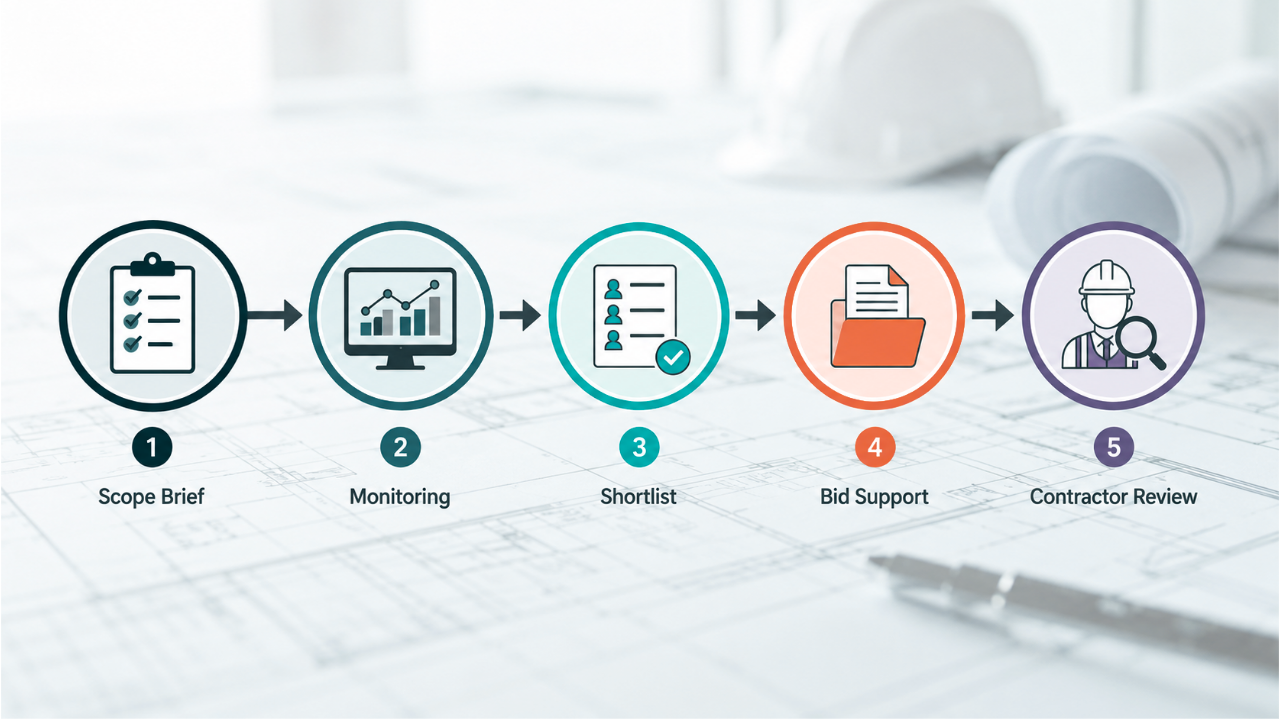
Step 4: Bid Support
Once you decide to pursue a project, the outsourced team shifts into bid support mode. This is distinct from shortlist delivery, bid support is active, document-level work tied to a specific project.
Bid support typically includes:
- Reviewing the bid documents and flagging scope gaps
- Preparing bid forms and ensuring compliance with submission requirements
- Coordinating RFQs from vendors and material suppliers
- Compiling bid packages for your final review
Importantly, this support excludes pricing strategy. The numbers, your labor rates, your margin targets, your buy-out strategy with subs remain entirely with you. No outside firm should be telling you what to charge. Their job is to make sure your bid is complete, accurate in format, and submitted correctly.
This is where outsourced estimating support for contractors adds the most visible impact on win rates. According to FMI Corporation’s 2025 construction technology survey, contractors using dedicated bid management support win 31% more bids than those relying on manual tracking. Best Construction Bid Management Tools 2026
If you want to see how this kind of end-to-end support is structured for specialty trade contractors, visit our estimation services page and schedule a free consultation to help you understand the full scope of what a dedicated team handles, from QTOs and plan reviews to bid form preparation and vendor coordination.
Step 5: What the Contractor Still Owns?
This is the part that most contractors ask about first and rightfully so. Even when you fully outsource ITB management, the contractor retains ownership of:
Final bid decisions. You decide which jobs to pursue and when to no-bid. Nobody else.
GC relationships. Your history with a particular GC, your track record on their jobs, your preferred contact, that stays with you. The outsourced team does not manage those relationships or communicate with GCs on your behalf unless you explicitly ask them to.
Scope judgment. When there is ambiguity in the drawings or a scope gap that could go either way, you make the call. The outsourced team flags it and you make the final decision.
This division is not a limitation, it is the design. The small contractor bidding process becomes faster and more consistent because the administrative weight is handled externally, while the strategic judgment stays internal.
The “They Won’t Understand My Trade” Fear
This objection comes up constantly, and it is a legitimate concern. Construction is trade-specific and a team that handles drywall scopes cannot be expected to read mechanical drawings with the same fluency. Similarly, a generalist who has never seen a fencing proposal is not well-positioned to build one. The answer is not to dismiss that concern, it is to address it structurally.
A team that is built around construction bid management outsourcing for specialty trades, not general business process outsourcing, staff estimators with actual trade experience. There is a difference between a team that “supports construction” and a team that has estimators who have worked roofing, HVAC, electrical, and drywall scopes specifically.
Our construction estimating team works across trade-specific scopes for U.S. contractors, fencing, roofing, HVAC, electrical, drywall, and more, using tools like PlanSwift, Bluebeam, and RSMeans to ensure takeoffs and bid packages reflect the technical standards of each trade. and no learning curve on your project.

Check out our How-it-works page and client testimonials to see how engagements are structured so contractors can evaluate fit before committing.
What You Actually Hand Over?
For clarity, here is a direct summary of what moves to the outsourced team versus what stays with you:
Handed over:
- ITB monitoring and platform tracking
- Addendum management and document distribution
- Shortlist filtering and opportunity curation
- Bid form preparation and compliance review
- Vendor RFQ coordination
- Deadline tracking and bid calendar management
Stays with you:
- Pricing and margin decisions
- GC relationship management
- Scope judgment calls
- Final bid approval and submission authorization
- No-bid decisions
When you outsource ITB management with this structure, the contractor’s capacity to pursue work goes up, not because the contractor is doing less, but because every hour is directed at judgment-level work rather than administrative processing.
Is This Right for a Small Contractor?
Our system is designed to work for all SMBs in construction, offering flexible engagement models including full-time dedicated support, part-time assistance, or project-based services. You can easily scale your support up or down based on your business needs and growth stage.
We operate as a strategic partner rather than a staffing agency or pure consultant, providing comprehensive support to help increase your revenue. We do not replace your internal team, rather we function as a seamless extension of your existing team.
The decision to outsource ITB management depends on your current bid volume and internal processes.
Schedule a free consultation now to find out what would work best for you.

Conclusion
Outsourcing ITB management is not about giving up control of your bid process. It is about structuring it so that your time is spent where it matters, on pricing strategy, GC & vendor relationships, and scope judgment, while a dedicated team handles the monitoring, documentation, and bid support work that buries most SMBs.
This step to outsource ITB management is most beneficial when internal capacity constraints affect bidding performance. Firms experiencing consistent process bottlenecks can achieve improved efficiency and higher win rates through structured external support. In such cases, deciding to Outsource ITB Management allows contractors to scale bidding efforts and increase winning bid rate.
FAQ Section
What is ITB management, and why should a contractor consider outsourcing it?
ITB management is the process of monitoring Invitations to Bid from general contractors, tracking addenda and plan releases, curating bid opportunities, preparing bid forms, and managing submission deadlines. Handling all of this internally while also running active projects creates bottlenecks that lead to missed bids and incomplete submissions. Outsourcing estimation & ITB allows your team to focus on winning bids and growing your business.
Will an outsourced team understand the specific scope of my trade?
This depends entirely on who you work with. Our team works across specialty trade scopes including concrete, painting, drywall, HVAC, electrical, plumbing, flooring, fencing, steel, and more using trade-standard tools. The right question to ask any provider is: who specifically will be reading my drawings, and what is their trade background?
Do I lose control of my bid decisions when I outsource ITB management?
No. The outsourced team handles monitoring, document tracking, shortlist curation, and bid form preparation. Final pricing, scope judgment calls, GC relationships, and submission authorization remain entirely with the contractor. Nothing is submitted on your behalf without your approval.
How does VASL structure its ITB management and bid support engagements?
We work with U.S. contractors on a scope-defined basis, starting with a brief that captures your trade, geography, project type preferences, and volume targets. From there, the team handles platform monitoring, shortlist delivery, bid form prep, and vendor RFQ coordination. Contractors can also engage VASL for a dedicated embedded estimator for higher-volume, ongoing needs.
For more details visit our estimation services page.
What construction platforms does an outsourced ITB team typically monitor?
Most engagements cover the major platforms where GCs post ITBs, BuildingConnected (Autodesk), ConstructConnect, PlanHub, SmartBid, and regional public bid portals. The platforms covered should match your market. A good outsourced team will ask which platforms your GC relationships use and prioritize accordingly, rather than defaulting to a generic platform list.
How quickly can a small contractor get started with outsourced bid management?
Onboarding is typically straightforward. The scope, brief and trade parameters can usually be defined in one or two conversations. Most contractors are operational within one to two weeks of starting. The ramp-up period is when the outsourced team calibrates the shortlist criteria based on feedback, refining what fits and what to filter out. After that, the workflow runs consistently without requiring daily input from the contractor.
Published on: June 29th,2026
Author: VASL Team