


Published by: VASL Team
Published on: June 22, 2026.
TL;DR
Table Of Contents
- What is Manual Bookkeeping (And Why It’s Costing You Money)?
- What is the Real Cost of Manual Bookkeeping for Contractors?
- Manual Bookkeeping vs. Professional Bookkeeping Services
- Why Manual Bookkeeping Drains Profitability?
- How Outsourced Bookkeeping Works for Construction?
- How to Implement Bookkeeping for Your Business?
- How to Choose the Right Bookkeeping Partner?
- What are the Common Mistakes Contractors Make?
- How to Measure ROI of Outsourced Bookkeeping?
- Questions Contractors Ask
- What’s Next for Construction Bookkeeping?
- FAQs
What is Manual Bookkeeping?
And Why It’s Costing You Money?
Manual bookkeeping refers to the practice of recording financial transactions, invoices, expenses, and payroll by hand or through spreadsheets without professional oversight or automated systems. For contractors managing manual bookkeeping, this typically means:
- Manually entering invoices into spreadsheets
- Tracking job costs through scattered documents
- Reconciling bank statements without software assistance
- Calculating payroll manually each pay period
- Managing tax deductions and quarterly payments independently
The construction industry has unique challenges that make manual bookkeeping particularly problematic. Unlike retail or service businesses with simple revenue streams, contractors juggle multiple job sites, equipment costs, labor allocation, and complex job costing requirements.
Construction companies with manual financial management report 3-5x higher error rates, missing tax deductions worth thousands annually, and cash flow visibility that lags behind reality by weeks or months.

What Is The Real Cost Of Manual Bookkeeping For Contractors?
When contractors handle manual bookkeeping themselves or assign it to an untrained employee, the true costs extend far beyond lost accounting hours.
1. The Silent Profitability Killer
Time is money. Most contractors managing manual bookkeeping spend 15-20 hours per week on administrative tasks that could be completed in 2-3 hours with professional support. For a contractor billing at $150/hour, those hours represent $11,400-$15,200 monthly in lost revenue-generating capacity.
Having a dedicated extension of your team through outsourcing, automates various processes, such as tracking expenses, generating invoices, and reconciling bank statements. This reduces the time contractors spend on administrative tasks, allowing them to focus on core business activities. lumberfi.com
2. The High Cost of Disorganized Finances
According to recent data, the construction industry faces significant challenges. Construction businesses also share a similar first-year failure rate of 25%, with only 40% surviving by year five, resulting in a 60% failure rate.
Additionally, research from the U.S. Bureau of Labor Statistics shows only 14.1% of the 69,296 private construction establishments that opened in the year ending March 2001 were still operating 24 years later, as of March 2025.
One critical factor driving these failures is poor financial management. According to industry data, nearly 60 percent of construction companies that fail do so not because of a lack of work, but because of preventable financial mismanagement and lack of real-time visibility into job profitability. zippia
3. Cash Flow Drag in Late Invoice Collection
Chaser’s 2026 accounts receivable research found that 100% of construction businesses are paid late, with 44% waiting more than 30 days beyond the invoice due date, pointing to sector DSO figures well above the 45-day benchmark.
When manual bookkeeping processes lack system integration and automated follow-up, the impact on cash flow is severe:
- Average invoice goes out 4-6 days late (vs. same day with automated systems)
- Uncollected receivables average 15-30 days longer when tracked manually
- For a $2 million annual revenue contractor, that’s $25,000-$50,000 in delayed cash flow
Chaser’s 2026 AR report found that businesses following up on 100% of overdue invoices are 76% more likely to be paid within one week, and businesses using AR automation software are 52% more likely to be paid within two weeks than those that are not.
4. Tax Compliance Risks in 2026
Construction contractors face unprecedented scrutiny from tax authorities. The Internal Revenue Service (IRS) and U.S. Department of Justice (DOJ) are targeting small businesses, construction companies, and their executives in 2026.taxgpt.com
Common manual bookkeeping errors that trigger audits include:
- Employee misclassification: Misclassifying employees as independent contractors can lead to significant penalties. The construction industry accounts for a substantial portion of misclassification audits.
- Inadequate documentation: Claiming excessive deductions without proper documentation can raise red flags.
- Inadequate job costing: Underreporting income is a primary audit trigger. Common issues include:
- Unreported retainage: Recognize retainage as income when billed, not when received.
- Cash payments: Maintain thorough records of all cash transactions to ensure accurate reporting.
5. Missed Tax Deductions & Depreciation Changes
2026 brings significant changes to construction tax incentives. The once-generous 100% bonus depreciation under the TCJA is winding down. In 2025, the rate drops to 40%, then to 20% in 2026, and disappears entirely by 2027.
However, under the “One Big Beautiful Bill Act,” 100% bonus depreciation has been permanently reinstated for qualifying equipment and vehicles placed in service after January 19, 2025. taxgpt.com
Contractors managing manual bookkeeping often miss these opportunities because:
- Equipment depreciation schedules aren’t tracked systematically
- R&D tax treatment opportunities go unidentified
- Construction companies that innovate can now deduct research expenses in the year they’re incurred, rather than capitalizing them over five years. Without proper systems, this benefit is lost.
Manual Bookkeeping Vs. Professional Outsourced Bookkeeping
|
Manual Bookkeeping |
Outsourced Bookkeeping |
|
|
Time Investment |
15-20 hours/week |
2-3 hours/week of owner oversight |
|
Error Rate |
3-8% of transactions |
<0.5% of transactions |
|
Job Costing Accuracy |
Estimated (50-70% accuracy) |
Detailed tracking (99%+ accuracy) |
|
Tax Deduction Capture |
60-70% of eligible deductions |
95%+ of eligible deductions |
|
Monthly Close Time |
7-10 business days |
3-5 business days |
|
Invoice Aging |
35-45 days average |
18-25 days average |
|
QuickBooks for Construction Setup |
Owner-configured (often incomplete) |
Professional setup with industry best practices |
|
Compliance Risk |
High (missed filings, wrong classifications) |
Minimal (proactive compliance management) |
|
Decision-Making Data |
Delayed, unreliable |
Real-time, accurate |
|
Cost Structure |
Hidden costs in lost time and errors |
Fixed, predictable monthly fee |
Why Manual Bookkeeping Drains Profitability?
The problem with manual bookkeeping isn’t just the obvious time drain. The real damage comes from cascading effects that compound over quarters and years.
1. Underpriced Jobs
Inaccurate job costing from manual bookkeeping systems, leads to underbidding profitable work and overbidding money-losing projects. A roofing contractor we worked with realized through bookkeeping analysis that tear-off jobs were losing $1,200 per project due to miscalculated labor costs. They’d completed 47 unprofitable jobs that year.
2. Tax Liability Surprises
Contractors managing manual bookkeeping independently often discover at tax time they owe $5,000-$15,000 more than expected because:
- Equipment depreciation wasn’t captured
- Vehicle deductions were incomplete
- Quarterly estimated taxes weren’t calculated correctly
- Business use of home deductions were missed
3. Loan Application Rejection
When contractors apply for growth capital, lenders scrutinize bookkeeping quality. Disorganized bookkeeping creates red flags that lead to loan denials or require external reconciliation (adding $2,000-$5,000 in accounting fees).
4. Employee Trust Issues
Staff members question payroll accuracy when manual bookkeeping errors occur. Even one miscalculation damages morale and retention.
Construction Industry Data (2026)
Every dollar that flows through your business, labor hours, material purchases, subcontractor invoices, equipment costs, and overhead, gets allocated to the correct job and cost code. This is the core of construction bookkeeping for contractors. Without this system, contractors operate blind:
- Can’t answer: Which job types are actually profitable?
- Can’t identify: Which subcontractors are overcharging?
- Can’t forecast: Cash needs for next quarter
- Can’t optimize: Pricing strategy based on actual costs
How Outsourced Bookkeeping Works for Construction?
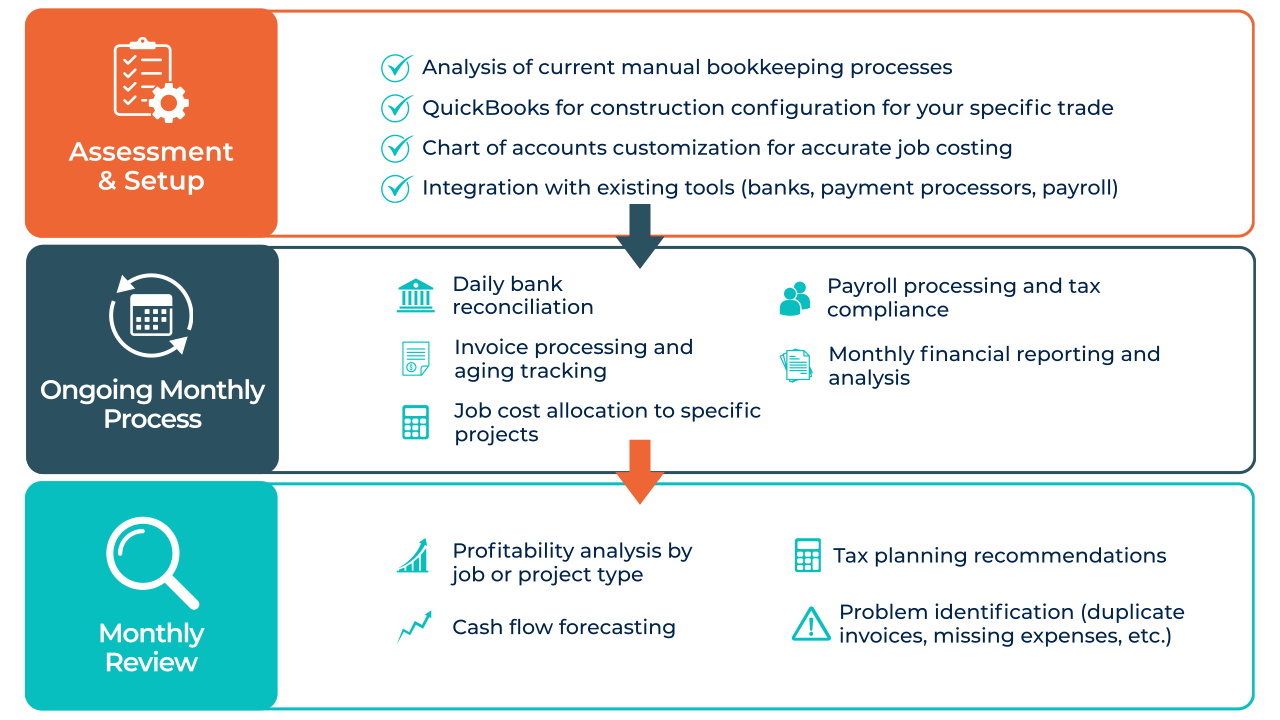
While manual bookkeeping creates a historical record after transactions occur, professional services proactively manage finances to optimize outcomes.
How To Implement Bookkeeping For Your Business?
1. Assess Your Current Bookkeeping Situation
Before engaging a bookkeeping service, document:
- Current systems (spreadsheets, accounting software, or paper)
- Time spent weekly on manual bookkeeping tasks
- Known errors or compliance concerns
- Specific pain points (tax planning, job costing, cash flow visibility)
- Integration requirements (payroll, bank accounts, customer accounting)
2. Choose the Right Bookkeeping Partner
Look for a provider that specializes in construction and understands:
- Job costing requirements for your trade
- QuickBooks for construction best practices
- Construction industry tax deductions
- Time tracking integration
- Subcontractor management
3. Provide Transaction Access
Set up bank account connections and document access so the bookkeeping service can:
- Monitor transactions daily
- Categorize expenses accurately
- Track job costs in real-time
- Identify anomalies (duplicate charges, missing invoices)
4. Establish Communication Protocols
Schedule:
- Monthly review meetings (30-60 minutes)
- Quarterly tax planning sessions
- Ad-hoc check-ins for urgent questions
- Annual strategy reviews
5. Measure & Optimize
Track key metrics:
- Time freed up from manual bookkeeping
- Error reduction vs. previous manual bookkeeping period
- Tax deductions captured
- Cash flow improvement
- Job profitability clarity
How To Choose The Right Bookkeeping Partner?
When selecting a professional to manage your financial operations instead of manual bookkeeping, prioritize:
1. Construction Industry Specialization
Look for providers who understand:
- QuickBooks for construction configuration
- Job costing methodologies for your trade
- How much time do contractors spend on manual bookkeeping (and where to optimize)
- Subcontractor compliance and 1099 management
- Equipment capitalization and depreciation schedules
2. Technology Integration
Ensure they support:
- Your current accounting software (QuickBooks, Xero, etc.)
- Bank account connections for daily reconciliation
- Time tracking system integration
- Payroll platform integration
- Mobile app access for receipt capture
3. Proactive Communication
The best bookkeeping partners don’t just record transactions, they alert you to:
- Cash flow concerns before they become problems
- Tax planning opportunities
- Profitability trends
- Job costing errors contractor patterns before they multiply
4. Transparent Pricing
Avoid providers with hidden fees. Understand:
- Fixed monthly fee vs. transaction-based pricing
- What’s included (tax prep? Payroll? Financial reporting?)
- Add-on costs for special services
- Cancellation terms
5. Audit Trail & Compliance
Verify they maintain:
- Complete audit trails for all entries
- Compliance with construction industry standards
- Regular backups and data security
- Proactive tax filing management
What Are The Common Mistakes Contractors Make?
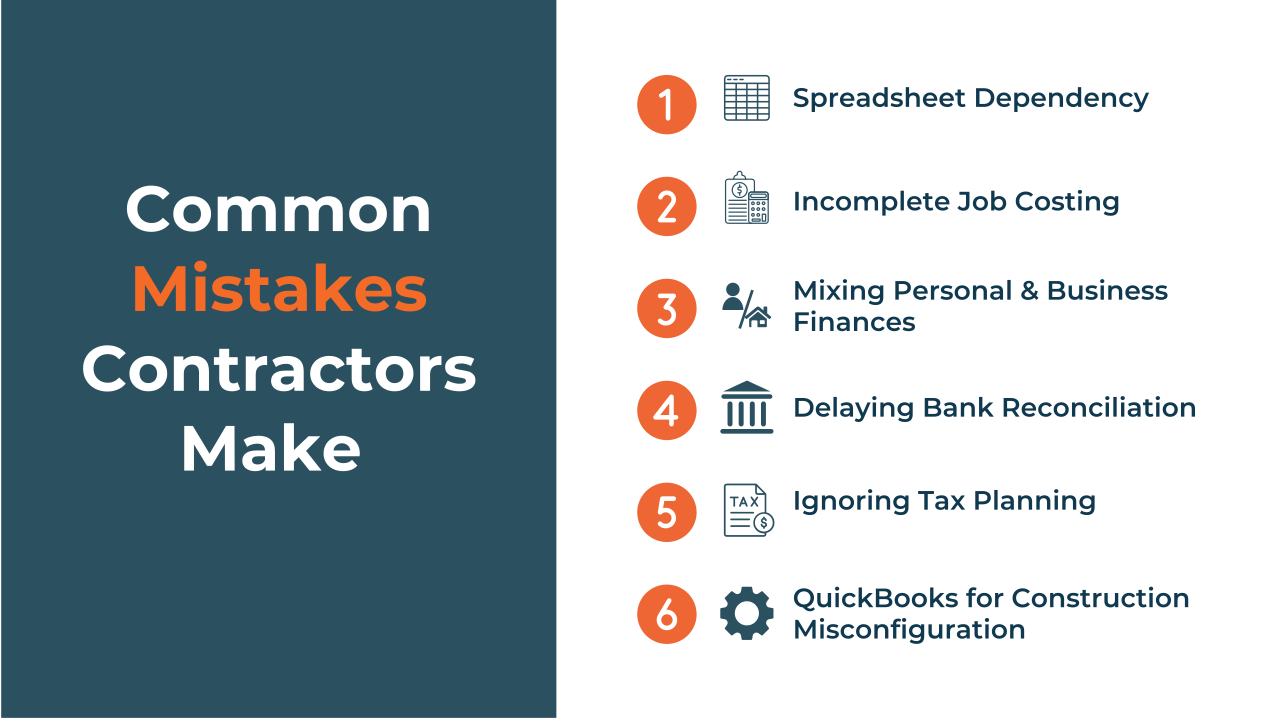
1. Spreadsheet Dependency
Many contractors think manual bookkeeping through Excel is good enough. But it can have problem like
- No audit trail: Can’t track who changed what, when
- No integration: Data must be entered multiple times
- No safeguards: One deleted formula breaks everything
- No scalability: Spreadsheets become unwieldy at 5,000+ transactions
2. Incomplete Job Costing
Contractors often don’t allocate all labor to specific jobs in bookkeeping systems, resulting in:
- Phantom profitability (jobs appear profitable because costs were never assigned)
- Future mispricing based on false historical data
- Inability to identify which job types are actually profitable
3. Mixing Personal & Business Finances
Using personal accounts for business expenses complicates manual bookkeeping, creates tax complications, and obscures true business profitability.
4. Delaying Bank Reconciliation
Contractors managing manual bookkeeping often reconcile quarterly or annually. This means:
- Errors compound over months
- Fraudulent transactions aren’t caught quickly
- Cash flow forecasting is based on outdated data
5. Ignoring Tax Planning
Manual bookkeeping often becomes a reactive system that captures history but doesn’t plan for tax liability or optimization:
- Quarterly estimated taxes are surprises instead of planned
- Available deductions are missed
- Tax liability balloons at year-end
6. QuickBooks for Construction Misconfiguration
Many contractors set up QuickBooks for construction without professional guidance, resulting in:
- Chart of accounts that doesn’t support job costing
- Missing or misallocated job cost categories
- Reports that don’t match reality
What Are The Best Practices For Your Construction Company?
1: Daily Bank Reconciliation
Even with manual bookkeeping processes, daily monitoring of transactions identifies:
- Duplicate charges
- Missing invoices
- Fraudulent transactions
- Cash position accuracy
You need to use bank feeds in your accounting software for automatic transaction imports.
2: Job-Level Cost Tracking
Every invoice and labor hour should be allocated to a specific job or project. This enables:
- Real profitability analysis by job type
- Accurate future estimating
- Identification of job costing errors contractor patterns
The best thing is to configure QuickBooks for construction with job-specific tracking codes.
3. Monthly Close Process
Complete your financial close within 5 business days of month-end. This enables:
- Timely profitability analysis
- Quick problem identification
- Better cash flow forecasting
A better approach is to establish a consistent monthly close checklist and timeline.
4. Quarterly Tax Planning
Don’t wait until year-end to address taxes. Quarterly reviews allow you to:
- Adjust estimated tax payments
- Identify deduction opportunities
- Plan for liability
You should schedule quarterly meetings with your bookkeeping provider (or accountant if managing independently).
5. Cash Flow Forecasting
Build a 12-month cash flow forecast including:
- Seasonal revenue fluctuations
- Planned equipment purchases
- Payroll obligations
- Tax liability expectations
Use historical data from professional bookkeeping to build accurate forecasts.
How To Measure The ROI Of Outsourced Bookkeeping?
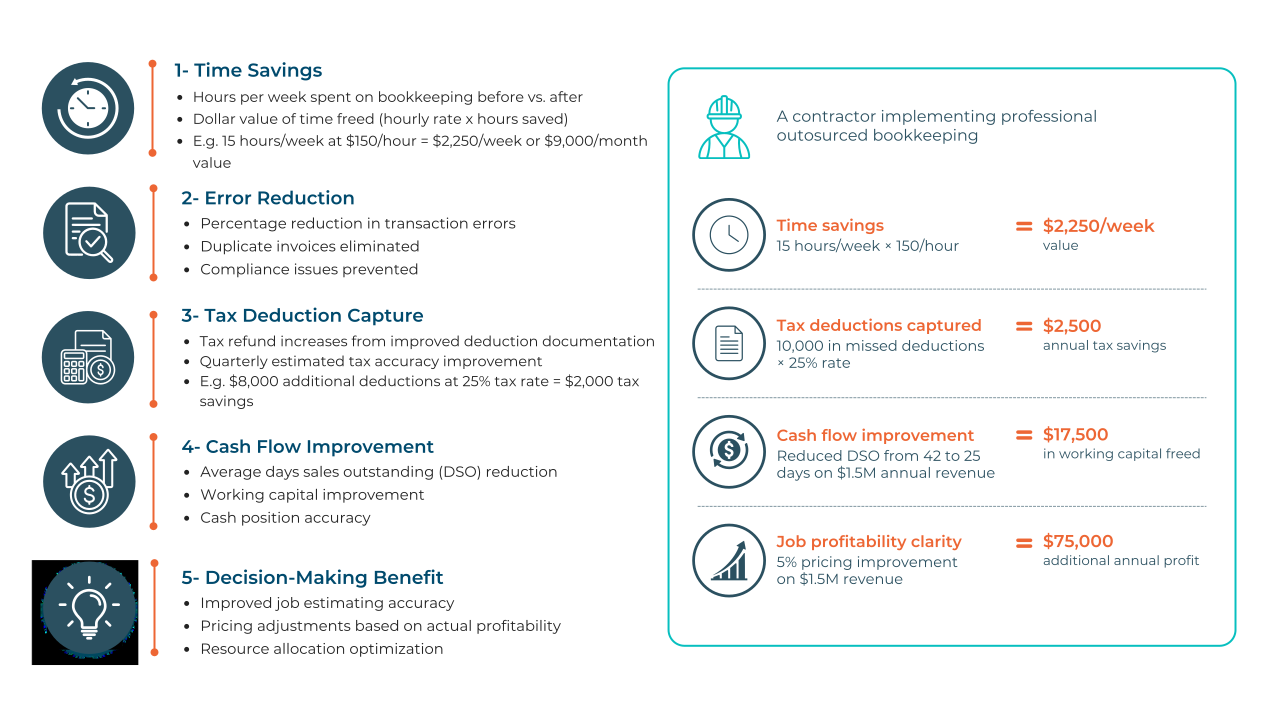
Total First-Year Benefit: $97,250+
Typical Bookkeeping Service Cost: $400-$800/month ($4,800-$9,600 annually)
Net ROI: 900-2000%+ in first year
Questions Contractors Ask
Q: We have an in-house team doing our bookkeeping currently. Why should we outsource?
Your in-house team likely spends 15-20 hours weekly on bookkeeping that could be completed in 2-3 hours with professional support. That’s valuable time that could be spent on revenue-generating activities. We complement your team by handling complex, time-consuming tasks so they can focus on core work. Many contractors find that their administrative staff transitions to higher-value roles (customer service, scheduling) once routine bookkeeping is outsourced.
Q: We’re happy with our current provider. What value would switching bring?
Many clients felt the same way until they saw our added value and savings. Construction-specialized bookkeeping brings insights that generalist providers miss: job profitability analysis, why contractors outsource bookkeeping (and the specific benefits), and proactive tax planning. We often discover $8,000-$15,000 in annual value within the first 60 days through deduction optimization and error correction alone. Can we show you the difference with a specific analysis of your situation?
Q: No budget right now. Outsourcing bookkeeping seems expensive.
Our services often pay for themselves through cost savings and better cash flow. A typical contractor sees $2,000-$3,000 monthly in value through time savings, error reduction, and tax optimization. Within 4-6 months, the service essentially becomes free. Let’s explore options that fit your budget, or we can start with a pilot project to prove value before full commitment.
Q: We handle everything internally. Isn’t outsourcing complicated?
We bring specialized expertise and free up your internal resources. The transition is smooth: we assess your current manual bookkeeping processes (usually 1-2 weeks), set up proper systems (2-3 weeks), and gradually take over routine tasks while training your team. Within 30 days, you’ll have access to better financial visibility than your internal team could provide alone.
Q: We’ve never outsourced before. Is this the right first step?
Many were hesitant at first. We can start with a pilot to prove value. A common approach is outsourcing monthly bookkeeping (invoicing, expense tracking, bank reconciliation) while keeping payroll in-house initially. After 2-3 months of proven results, most contractors expand to full services. We can also start with just a financial review to identify opportunities.
Q: Now doesn’t feel like the right time.
Improving finances delivers immediate benefits. Better cash flow and profitability visibility directly support growth planning. Even if you’re planning to scale up operations, now is the ideal time to establish clean financial systems that will support that growth. Let’s discuss a flexible timeline that works for your business cycle.
Q: We had a bad experience outsourcing before.
We prioritize quality and transparency. Every client gets a dedicated account manager, monthly communication, and quarterly business reviews. We’re happy to share references from construction contractors and case studies showing how we’ve turned around struggling bookkeeping situations. Many of our best clients came to us after negative prior experiences.
Q: We’re a small company. Is professional bookkeeping really necessary for us?
Our services are scalable and built for small and mid-sized businesses. A solo contractor or 3-person team with $300K-$500K annual revenue benefits enormously from outsourced bookkeeping. In fact, smaller companies often see higher ROI percentage because the time savings represent a larger percentage of the owner’s capacity. We scale our services up as you grow.
Q: We need to discuss this with our team/partners before deciding.
Of course. I can provide materials or join a follow-up discussion with your team. We find it helpful to include the person(s) who would be freed up by outsourcing, as they often see the biggest immediate benefit. Would a meeting with your leadership team be helpful?
Q: We use different accounting software, not QuickBooks.
No problem. We work with QuickBooks, Xero, SAP, and other construction-focused platforms. Our expertise translates across systems, the principles of accurate job costing, daily reconciliation, and cash flow management apply regardless of software. In fact, we often recommend software changes only when the current platform isn’t meeting specific needs.
Q: We’re concerned about the cost.
We provide cost-benefit clarity and long-term savings analysis. Most contractors save $2,000-$5,000 monthly through time value alone, plus additional value through tax deductions and error prevention. We show you exactly where the value comes from and why it’s worth the investment. Would a detailed cost-benefit analysis be helpful?
Q: Are you sure about quality? How do I know I can trust you?
Experienced professionals + strict quality controls + references. Every engagement includes a quality assurance review, monthly client meetings, and regular audits of our work. All our team members are trained in construction accounting. We also provide detailed documentation of everything we do so you have complete visibility. Request our references from similar contractors, they’ll give you honest feedback.
Q: Our financials are complex. How do we handle multiple entities or specialized structures?
We specialize in complex financial structures across construction industries. Whether you’re managing multiple LLCs, have equipment leasing arrangements, or operate partnership structures, we’ve handled these scenarios. Complexity is often why contractors benefit most from professional bookkeeping, there’s simply too much for manual bookkeeping to handle accurately.
Q: I’m still not sure if this is the right decision for us.
Let’s start with a consultation or trial period. We can review your current situation (usually 45 minutes), identify specific opportunities, and discuss a pilot project if that feels more comfortable. The goal is to prove value before you make a long-term commitment. Would a no-obligation consultation work for you?

What’s Next for Construction Bookkeeping?
The future of construction financial management involves integration of multiple systems: accounting software, job costing platforms, time tracking, payroll, and project management. Success requires not just accurate bookkeeping, but seamless data flow across all systems.
Emerging trends for contractors:
- Real-time job profitability (no waiting for month-end reports)
- Artificial intelligence for anomaly detection (automated error identification)
- Mobile-first operations (submitting receipts and timesheets from job sites)
- Integrated forecasting (combining historical data with project pipeline to predict cash needs)
- Automated tax optimization (continuous deduction recommendations, not annual surprises)
Manual bookkeeping is no longer sustainable for growing contractors. Professionals who embrace modern bookkeeping systems through outsourcing or internal investment gain competitive advantages in pricing accuracy, cash management, and profitability visibility.
The question isn’t whether your business can afford professional bookkeeping. It’s whether you can afford to continue managing manual bookkeeping yourself.
Ready To Stop Your Time On Manual Bookkeeping?
Most contractors manage bookkeeping because they’ve never experienced what professional support actually provides: cash flow clarity, profitable decision-making, and time freedom.
Don’t leave $10,000+ in annual value on the table.
- Identify hidden costs in your current bookkeeping approach
- Discover specific tax deductions you’re missing
- Understand how much money you could save monthly
- See exactly how much time you’d free up
Schedule your free consultation & get your Bookkeeping analysis today.
FAQs
What time do contractors typically spend on manual bookkeeping?
Industry research shows contractors spend 15-20 hours weekly on manual bookkeeping and related administrative tasks. For a contractor billing $100-$200/hour, that represents $1,500-$4,000 weekly in lost revenue-generating capacity. With professional bookkeeping, this drops to 2-3 hours weekly of review and decision-making.
How much can we expect to save by outsourcing bookkeeping?
Typical savings include:
- Time value: $800-$3,000/month (reduced from 15-20 hours to 2-3 hours weekly)
- Tax optimization: $200-$1,000/month (through deduction capture)
- Error prevention: $500-$2,000/month (duplicate invoices, cash application errors, compliance issues)
- Working capital improvement: $5,000-$25,000+ (through improved cash flow)
Total first-year value typically ranges $15,000-$60,000+, depending on business size and current situation.
Can we start with just a portion of our bookkeeping?
Absolutely. Many contractors begin with just bookkeeping outsourcing (transaction processing, invoicing, expense tracking, bank reconciliation) while keeping payroll and tax prep in-house. After 2-3 months of successful operation, most expand to full services. This trial approach helps prove value before full commitment.
What’s the difference between our current bookkeeper and a specialized service?
A specialized bookkeeping service brings:
- Construction industry expertise (understanding job costing, equipment, subcontractors)
- Scalability (systems that grow with you without proportionally increasing cost)
- Specialized software (QuickBooks for construction configuration for your trade)
- Proactive analysis (not just recording transactions, but identifying opportunities)
- Backup/redundancy (your financial data doesn’t rest on one person)
- Compliance focus (staying current with tax law changes and industry regulations)
How does professional bookkeeping improve cash flow?
Several ways:
- Faster invoicing (same-day vs. delayed)
- Better collections (aging reports trigger follow-up)
- Accurate receivables aging (you know what’s truly outstanding)
- Improved inventory management (for material-based contractors)
- Working capital optimization (strategic payment timing)
- Cash forecasting (planning for seasonal variations)
On average, contractors improve cash flow by $10,000-$50,000 in the first 90 days.
What about data security with an external bookkeeper?
Professional bookkeeping firms maintain:
- Bank-level encryption for all data
- Regular security audits
- Compliance with SOC 2 standards
- Automatic backups
- Disaster recovery procedures
- Limited access controls (only team members needing specific data)
Your data security typically improves with a professional service compared to manual processes where files might be stored locally.
How do we transition from our current system to professional bookkeeping?
Typical transition:
- Week 1: Assessment of current processes and data
- Week 2: QuickBooks for construction setup/configuration
- Week 3: Data conversion from existing system
- Week 4: Verification and reconciliation to bank statements
- Week 5+: Ongoing management with training for your team
Total transition typically takes 30-45 days, during which you maintain full operations.