


Published on: June 18th, 2026
Author: VASL Team
5 Financial Reports That Solve Cash Flow Problems
If your P&L looks healthy and your backlog is solid, but your bank account tells a different story, you are dealing with one of the most common cash flow problems in the industry.
According to Billd’s 2025 National Subcontractor Market Report, 40% of subcontractors retain half or more of their profits just to fund day-to-day operations. A separate Built / Talker Research Study (May 2025) found that 70% of contractors regularly face payment delays. These delays force them to inflate bids by an average of 8% to protect themselves.
The root cause is rarely the projects themselves. Most of the time, it comes down to a lack of financial clarity, too many numbers and not enough real insight. The right financial reports can change that.

Here are the five that matter most, and exactly what each one tells you about your cash flow problems.
1. What P&L Statement Really Tells You?
The P&L (also called the income statement) is usually the first report people open. It shows revenue at the top, subtracts costs like labor, materials, subcontractors, and overhead, and lands on your net profit or loss.
Most contractors review it once a quarter and move on. That is a mistake. A monthly P&L review helps you catch margin erosion early, before a bad month turns into a bad year.
What to look for:
- Estimation blog topics in inbox after first msg. This will go as more of a promotion msg few days after the first one. For informational reasons
- Is your gross profit margin holding steady? For general contractors, the industry average sits at 14.8% (CFMA Benchmarker). Specialty contractors should target 20-30%.
- Are overhead costs growing faster than revenue?
- Are certain job types consistently underperforming?
The P&L alone will not solve cash flow problems. A company can be profitable on paper and still run out of cash. That is exactly where the next report comes in.
2. The Simplified Cash Flow Statement
This report explains why your bank account does not match your P&L. It tracks actual money moving in and out of your business in three areas:
- Operating
- Investing
- Financing activities
Construction companies often face cash gaps because of how billing works. General contractors wait an average of 83 days to get paid, while subcontractors often wait longer. During that time, you still pay crews, suppliers, and subcontractors out of your own pocket. (Dodge Construction Network, 2024, via CEO Finance Academy, 2026)
The most important number is operating cash flow. If it stays negative while your P&L shows profit, you have a timing issue. You are doing the work but not collecting fast enough.
Avoid the crisis:
Spotting this early helps you fix cash flow problems before they become a crisis.
- Review this report monthly
- Check it at the project level too
- A job that looks profitable overall can quietly drain your reserves
Many contractors improve results faster by working with professionals who specialize in construction financial analysis and reporting. Learn more about expert analysis and reporting services.
3. Budget vs Actual Tracking: Where Real Decisions Get Made
The P&L shows where you ended up. Budget vs actual tracking shows you why. It compares what you planned to spend on a project against what you actually spent, line by line.
The Construction Financial Management Association (CFMA) consistently identifies poor job cost tracking as one of the top financial challenges in the industry. When you run multiple projects, costs can blur together. By the time you notice a job is over budget, it is often too late to recover the margin.
Done right, this report lets you:
- Spot which project phases run over estimate, so you can price more accurately next time.
- Identify whether overruns come from labor, materials, or subcontractors.
- Catch unapproved change order costs before they get absorbed into overhead.
Teams that use proactive financial management often find budget vs actual reporting to be the biggest unlock.
4. The WIP Report: The Most Underused Tool in Construction
The Work in Progress (WIP) report is unique to construction and arguably the most powerful financial report you are probably not using enough. It tells you where every active project stands right now: how much revenue you have earned, how much you have billed, and whether you are overbilled or underbilled.
Overbilling: Billing more than you have earned looks great for cash flow in the short term. But it creates a liability that will show up later, usually at the worst possible time.
Underbilling: Doing work you have not yet invoiced for ties up cash and inflates risk. A 2025 industry survey found that 43% of subcontractors report not having enough working capital to cover unexpected expenses or delays. Underbilling is one of the biggest hidden drivers of that problem. ceofinanceacademy
The American Institute of Certified Public Accountants (AICPA) treats the WIP schedule as a core component of sound construction financial reporting. Banks and sureties use it to assess your risk profile. You should be using it the same way, to catchcash flow problems before they show up in your bank account.
5. The Management Dashboard: Turning Data into Decisions
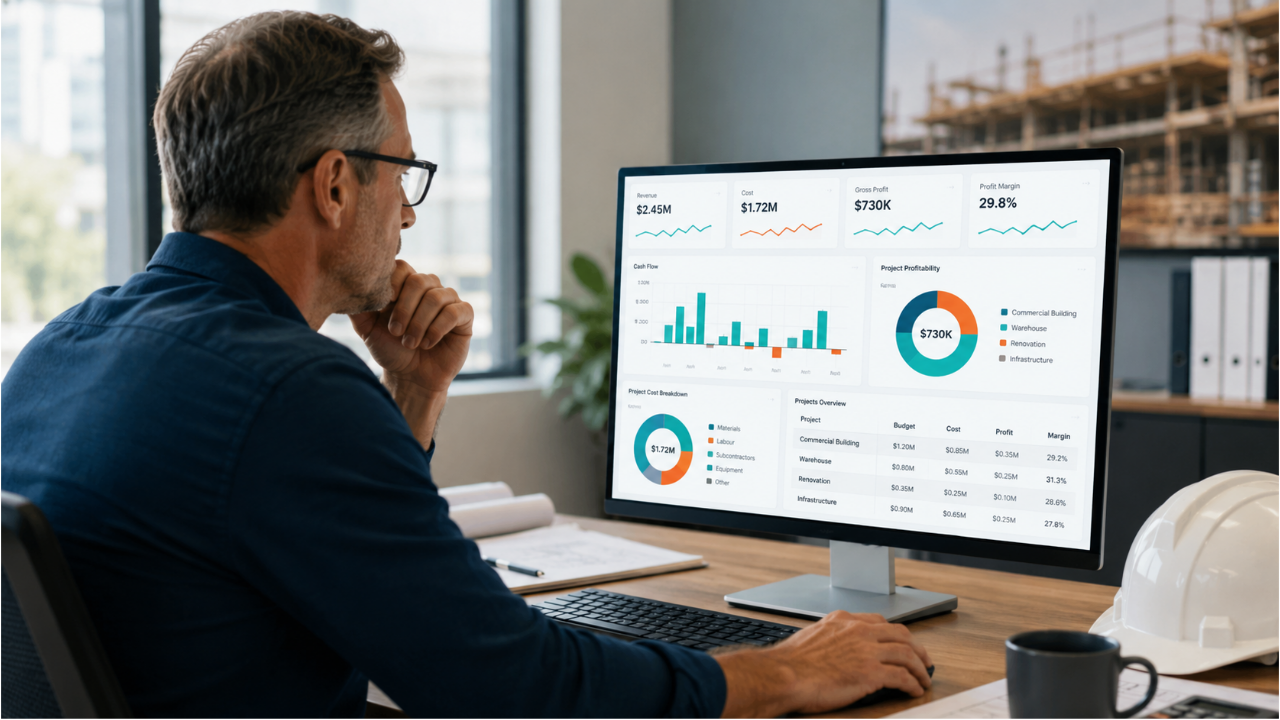
The first four reports give you raw data. A good management dashboard turns that data into insight. It pulls key numbers from your P&L, cash flow statement, WIP, and budget vs actual reports into one clear view.
Many contractors benefit from professional support to build and maintain these dashboards effectively. Explore expert analysis and reporting services here.
A strong dashboard for contractors shows:
- Gross margin by project (updated monthly)
- Cash position vs 90-day rolling forecast
- Billing lag by job
- Overhead as a percentage of revenue vs target
- Underbilling exposure across all projects
Most contractors try building this in spreadsheets and abandon it. Firms that work with specialized partners often move from data chaos to clear, actionable dashboards in just weeks.
The result is faster decisions. Contractors who review a unified dashboard monthly can bid with confidence, allocate crews efficiently, and avoid the cash flow problems that surprise many growing businesses.
What Changes When You Have Financial Clarity?
Financial clarity is not about knowing every number. It is about knowing the right numbers at the right time. When you have it, three things improve:
- Faster, more confident bidding
- Smarter resource allocation
- Fewer surprises
A McKinsey analysis found that construction companies using digital financial tools improved profitability by 15% to 25% and reduced mid-project cash crunches. The tools exist. The data is already in your business. What you need is a clear system to connect them.
Conclusion:
The five reports above create that system. Used together, they show you where your money is, where it is going, and what to do next. That is how you stop reacting to cash flow problems and start preventing them.
Ready to bring clarity and control to your financial reports? Getting the right systems and support in place can transform how you manage cash flow and make decisions. Discover how expert analysis and reporting can help your business.
Schedule a free consultation now!
FAQs
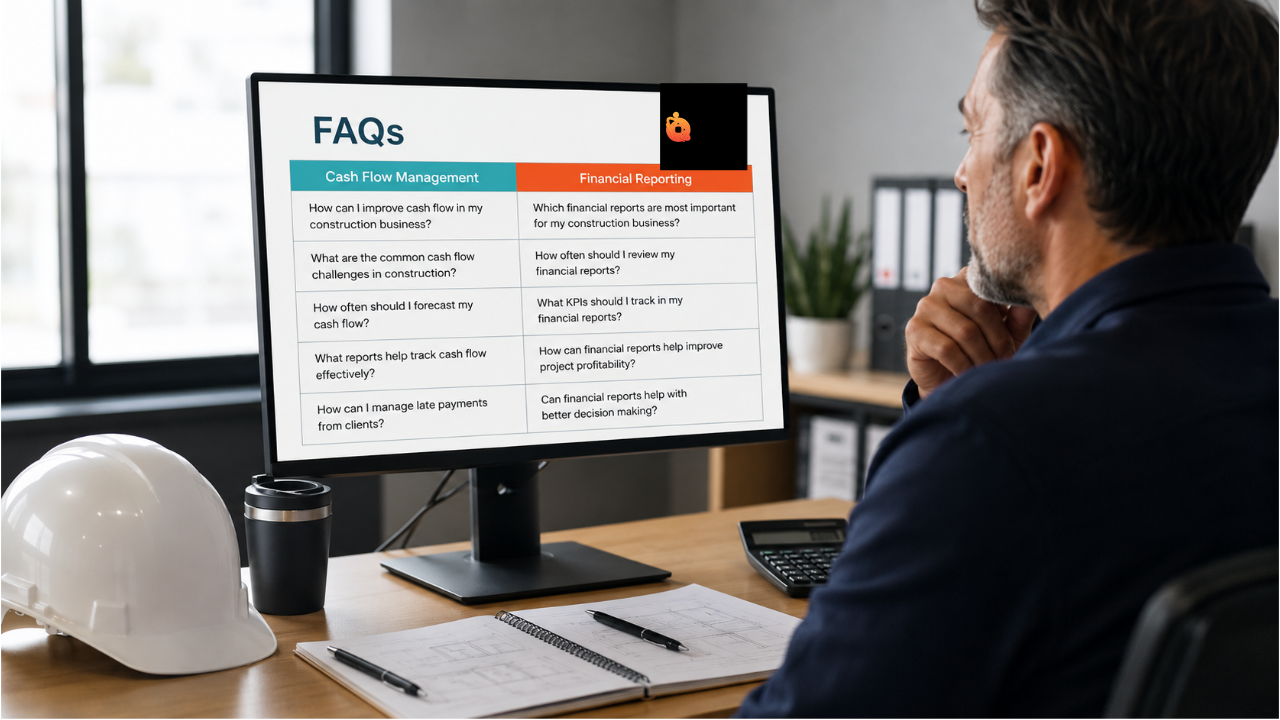
What causes most cash flow problems?
The leading causes are slow and unpredictable payments, underbilling on active projects, and a lack of regular financial reporting. According to Billd’s 2025 report, 40% of subcontractors retain half or more of their profits just to stay liquid. Without budget vs actual tracking and a cash flow statement reviewed monthly, most contractors do not catch the problem until it is already a crisis.
How often should a contractor review their financial reports?
Monthly is the minimum. Your P&L, cash flow statement, and WIP report should all be reviewed monthly, not at year end. Budget vs actual tracking should be live and checked after each project phase. Waiting longer means you are making decisions on stale data.
What is the difference between a P&L and a cash flow statement?
A P&L statement for contractors shows revenue minus expenses over a time period, it tells you whether the business is profitable. A cash flow statement shows actual money moving in and out, it tells you whether the business is liquid. You can be profitable on your P&L and still run out of cash if your collections are slow. Both reports together give you the full picture.
What does VASL offer for contractor financial reporting?
We provide accounting, financial controllership, and reporting services tailored to private businesses including construction contractors. Our team delivers P&L preparation, cash flow planning, budget vs actual tracking, and management dashboards, functioning as an in-house finance department at a fraction of the cost. Learn more about our financial & analysis services for your business.
How do I know if I have a cash flow problem or a profitability problem?
Compare your operating cash flow to your net income on the P&L. If net income is positive but operating cash flow is consistently negative, you have a timing problem, likely underbilling or slow collections. If both are negative, you have a profitability problem. The fix is different for each, which is why reviewing both reports together matters.
What is a WIP report and why does it matter for cash flow?
A Work in Progress (WIP) report tracks the financial status of every active project, earned revenue, billed amounts, and whether you are overbilled or underbilled. Underbilling ties up cash you have already earned. Overbilling creates a future liability. Sureties, banks, and lenders all review your WIP schedule when assessing financial risk. It is one of the most important tools for catching cash flow problems before they escalate.